
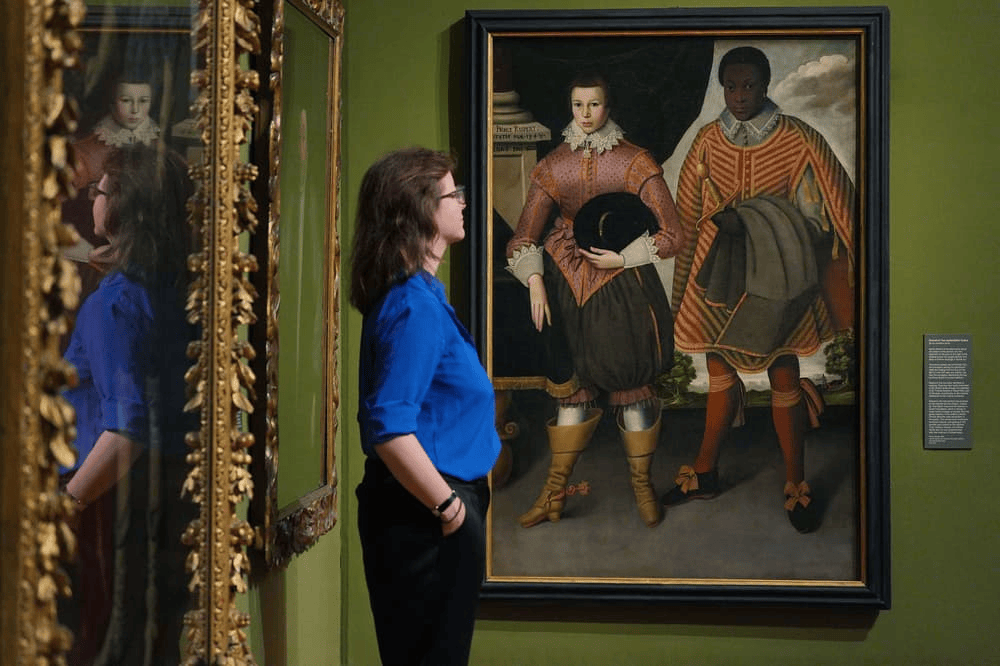
A remarkable 400-year-old portrait has gone on display at London’s National Portrait Gallery, offering a fascinating glimpse into the presence of people of African heritage in early 17th-century England.
The rare painting shows two teenage boys standing side by side. One is of African heritage, while the other is Caucasian. The identity of the second boy remains a mystery, but an inscription on the artwork identifies him as Prince Rupert, the nephew of King Charles I.
The National Portrait Gallery has now launched a major research project to discover more about the two young sitters and the circumstances surrounding the portrait. ([The Standard][1])
Rare Portrait Offers New Window Into English History
The painting is considered one of the earliest known full-length portraits of a Black sitter in Western art.
Created around four centuries ago by an unknown artist, the artwork has attracted fresh attention because so little is known about the African boy pictured alongside Prince Rupert.
Inscriptions on the painting indicate that both boys were aged 13. While Prince Rupert can be identified, researchers are still working to establish the name, background and relationship of his fellow sitter.
The National Portrait Gallery is bringing together specialists in early 17th-century portraiture, history and conservation to investigate the painting further. ([The Standard][1])
Who Is Prince Rupert in the Painting?
The boy identified in the portrait is Prince Rupert, who was a nephew of King Charles I.
His presence gives historians an important clue about the social and political circles surrounding the artwork. However, the identity of the African boy remains unknown.
Researchers are examining the painting, its inscriptions and historical connections in an effort to understand why the two boys were portrayed together.
The mystery surrounding the second sitter is one of the reasons the portrait has become such an intriguing addition to the National Portrait Gallery’s collection.
Painting Has Been Kept at Penshurst Place for Centuries
The historic portrait has been associated with Penshurst Place in Kent since at least 1743.
It belongs to Philip Sidney, 2nd Viscount De L’Isle, and has now been loaned to the National Portrait Gallery. Visitors will be able to see the artwork in Room Four, where it is scheduled to remain until March 2028. ([The Standard][1])
The painting’s long history at Penshurst Place adds another layer to the investigation, although there are no known 17th-century links between the artwork and the property.
Researchers Are Investigating Its Colonial Connections
The National Portrait Gallery is also examining possible connections between the sitters and influential families involved in England’s colonial networks.
Researchers believe the boys may have been connected to the Sidney family through networks associated with Sir Thomas Smythe or Robert Rich, Earl of Warwick.
Those networks were linked to the Virginia Company, an English trading organisation involved in the colonisation of parts of eastern North America.
The gallery’s research therefore goes beyond identifying the two boys. It is also exploring the wider political, commercial and social networks that shaped life in England during the early 1600s. ([The Standard][1])
National Portrait Gallery Carries Out Conservation Work
Before going on display, the portrait underwent technical analysis and treatment at the National Portrait Gallery’s conservation studio.
The project was carried out with the Sidney family and received funding from the Idlewild Trust and Historic Houses.
Conservation work allows specialists to examine the physical characteristics of the painting while helping preserve it for future visitors and researchers.
The gallery hopes the artwork will encourage visitors to reconsider assumptions about the presence and representation of people of African heritage in Europe during this period. ([The Standard][1])
What Does the Portrait Tell Us About 17th-Century Britain?
The painting provides an unusual visual record of a period when portraits were closely connected to status, family networks and power.
Its two young subjects raise questions about identity, friendship, household relationships and the international connections of wealthy English families.
However, researchers have not yet established exactly why the boys were painted together or what their relationship was.
That uncertainty makes the portrait particularly valuable from a historical research perspective. Rather than offering a complete story, it provides clues that historians can investigate further.
Charles I and Britain’s Wider Historical Context
The portrait also dates from the reign of King Charles I, who ruled England from 1625 until his execution in 1649.
Charles I was a major patron of the arts and an important figure in Britain’s political and cultural history. The National Gallery notes that his reign also had documented connections to the development of England’s involvement in the transatlantic slave trade. ([National Portrait Gallery][2])
The wider historical setting helps researchers understand the world in which the portrait was created, although the precise circumstances behind the two boys’ appearance together remain unknown.
A Historic Portrait Now on Display in London
For visitors to London, the newly displayed painting provides an opportunity to see a rare example of early English portraiture while also considering some of the unanswered questions surrounding its subjects.
The National Portrait Gallery in St Martin’s Place is free to enter and houses thousands of portraits and other works spanning centuries of British history. ([National Portrait Gallery][3])
The newly displayed portrait adds another intriguing chapter to that collection.
As historians continue their research, the identity of the African boy may eventually emerge. Until then, the mysterious 400-year-old painting remains both a remarkable work of art and an important piece of Britain’s complex social history.
For BritGossip readers interested in British history, London culture, royal connections, art and fascinating stories from the past, this rare National Portrait Gallery discovery offers plenty to explore.
This version keeps the story factual while giving it a Google Discover/UK news-magazine feel. It can also be tightened further into a 500–700-word breaking-news version for faster publishing.
The source of this news is The Standard.